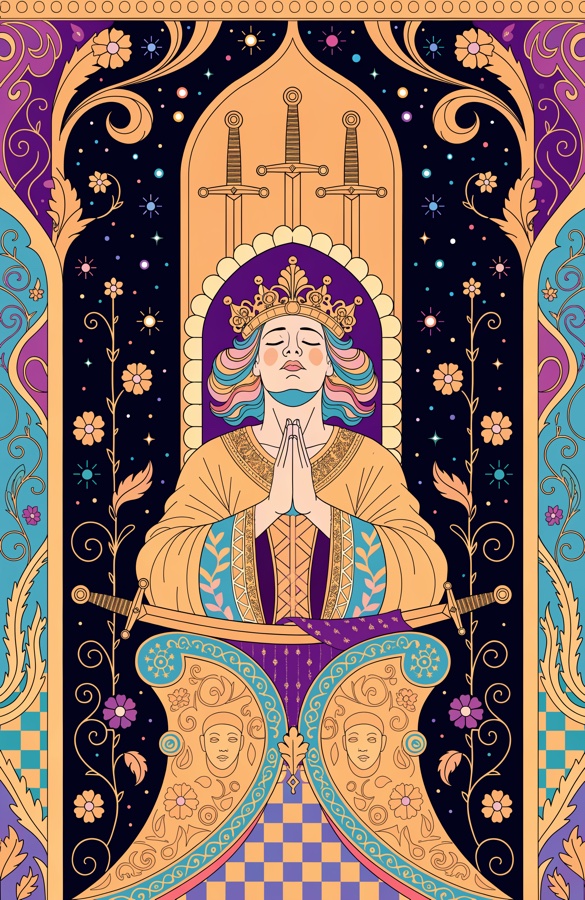
Four of Swords
The Four of Swords rests upon its tomb: rest, recovery, a needed pause after hardship.
Symbolism
The card depicts a knight lying motionless atop a stone tomb, hands folded as if in prayer, echoing the posture of medieval effigies found in old cathedrals. Three swords hang on the wall above him, pointing downward, while a fourth lies horizontally beneath his body, as though deliberately set aside. A stained glass window in the background shows a figure blessing a child, adding a touch of spiritual light and protection to an otherwise austere scene. The cold grays of the stone contrast with the softness suggested by the window, symbolizing the passage between worldly exhaustion and inner refuge. This image doesn't speak of death but of voluntary retreat, a restorative sleep meant to prepare for the battles yet to come.
Upright
The Four of Swords represents the necessary pause after tension, an invitation to lay down one's weapons and rebuild before facing challenges again. It speaks of active rest, the kind consciously chosen rather than the collapse that comes from total exhaustion. This is a time to withdraw from noise, cut off outside demands, and let the mind regenerate in stillness. The card reminds us that productivity isn't linear, and that even the most valiant warriors need periods of convalescence. It encourages honoring this need for rest without guilt, since it's precisely this respite that allows one to return with greater clarity and strength.
Reversed
Reversed, the Four of Swords often signals a return, the moment one finally steps out of rest and back into action, sometimes with renewed enthusiasm. But it can also point to the opposite, a deep exhaustion caused by refusing to stop, as though the signals from body and mind were ignored for far too long. This duality calls for honest reflection on where one truly stands, between a healthy return after genuine recovery and accumulated fatigue that was never properly addressed. In the latter case, it becomes urgent to slow down before the body forces a much harsher halt. The reversed card is both a warning sign and a promise of returning to active life.
In love
In love, this card suggests a necessary period of withdrawal within the relationship, a time to breathe away from recent tensions or conflicts. It can indicate a need for solitude before fully committing, or simply a pause to reconnect with oneself. For couples, it invites slowing the pace and creating shared moments of calm rather than filling every silence. This isn't a card of separation, but an invitation to gentleness and inner rebuilding.
At work
At work, the Four of Swords strongly advises resting before burnout hits, setting clear boundaries against an overwhelming workload. This is the time to delegate, postpone what can wait, and recognize that lasting performance depends on cycles of recovery. Financially, it may suggest pausing major decisions until clarity returns. Ignoring this signal risks leading to exhaustion, while heeding it allows for a stronger, more effective comeback.
Spiritual message
Spiritually, this card teaches that silence and withdrawal are sacred acts of healing, not signs of weakness. It invites us to honor the natural cycles of rest, just as nature itself alternates between blooming and dormancy. Resting here becomes a form of prayer, a way of reconnecting with one's inner strength.
The advice
Rest is not retreat: let yourself recover.
Did Four of Swords come up in your reading?
A card doesn't mean the same for everyone. Ask your question and draw your cards: your reading is written for you, your situation, your moment.
Get my reading→